The Compass Spread: A Tarot Layout for When You Need Direction

Disclaimer: This post contains affiliate links. If you make a purchase through them, we may earn a small commission at no extra cost to you.
When you feel completely lost, the compass tarot spread is exactly what you need. There are times when a reading does not need to tell you everything. It just needs to help you get your bearings.
The compass tarot spread is a simple four-card tarot layout for moments like that. If you feel pulled in too many directions, emotionally tired, or unsure what comes next, this spread gives you a way to pause and look at the situation from a calmer place.
What The Compass Tarot Spread Is For
Some spreads are better for detailed analysis. This one is better for orientation.
This compass tarot spread works well when you feel stuck, when you are in the middle of a transition, or when you know something has to shift but cannot yet see the shape of that change. It does not try to force certainty. It helps you notice where you are, what is falling away, what is beginning to appear, and what kind of step makes sense now.
The 4 Positions in the Compass Tarot Spread
| Position | What it shows | Helpful question |
|---|---|---|
| South | Your current ground, or where you are now | What is true for me at this moment? |
| West | What is behind you, fading, or ready to be left behind | What am I ready to release? |
| East | What is coming into view | What is beginning to emerge? |
| North | The next step or clearest direction forward | What would help me move forward now? |
This is part of what makes the spread so readable. Each card has a clear job, and together they create a sense of movement rather than a pile of disconnected insights.
If your question is about love or a relationship, you may also want to look at love tarot spreads.
How to Read the 4-Card Compass Layout
Shuffle with a clear question in mind. Not a huge life question if you can help it, just something honest and specific enough to hold.
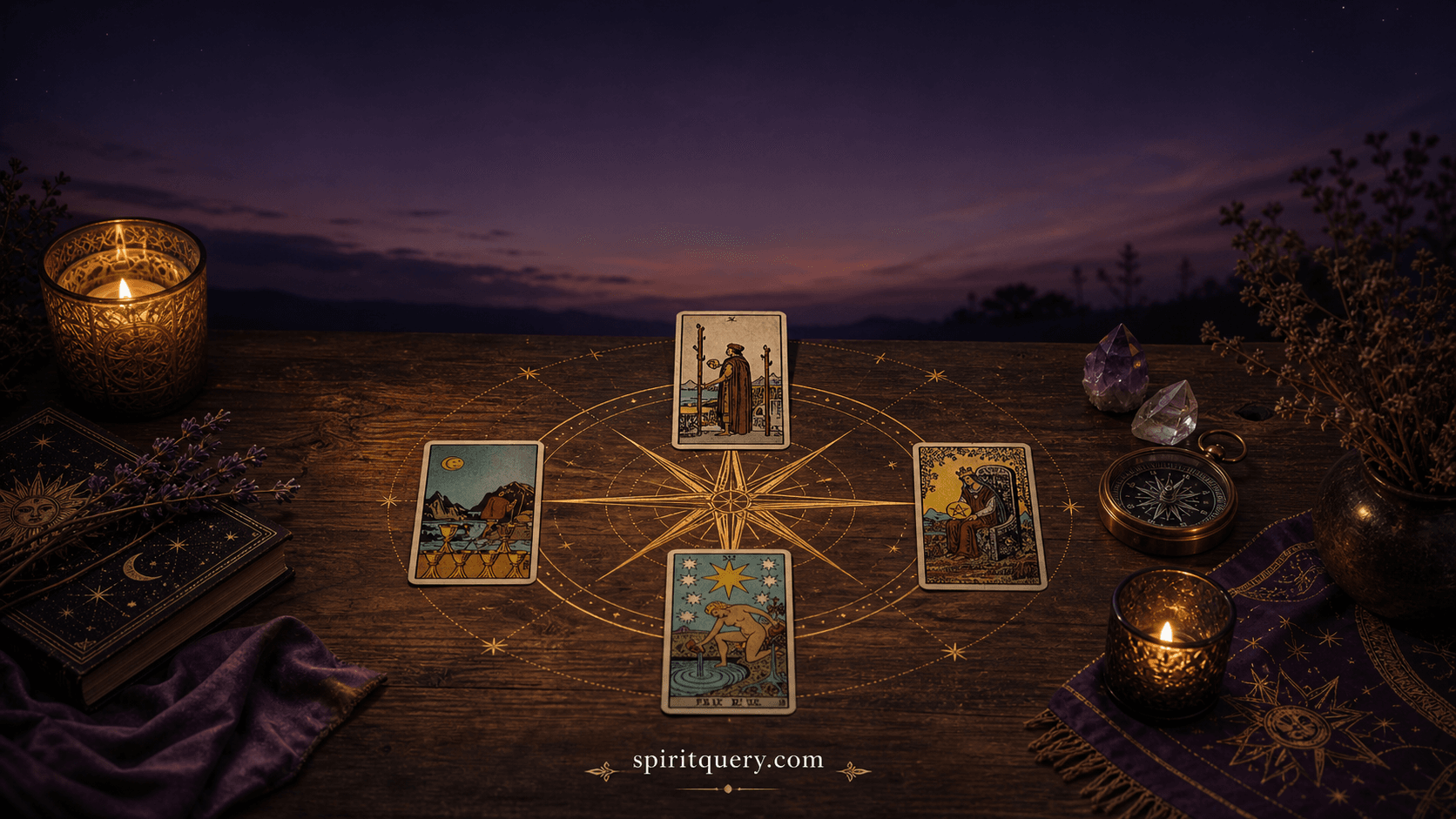
Then draw four cards and place them in this order:
You can lay the cards in a cross shape, with South at the bottom, West to the left, East to the right, and North at the top. The visual order matters because this spread is built around direction.
How to read it
Start with South. That card tells you what is actually happening now, not what you wish were happening and not what you are trying to fast-forward past.
Then look at West. This is often the card that shows an old pattern, a mindset, or a chapter that has already started to loosen its grip. East follows with what is beginning to open up, even if it still feels tentative. North comes last because it is the card that asks for response. Not a grand reinvention, necessarily. Just the next honest move.
If the reading feels quiet, that is not a problem. Quiet readings are often the most useful ones. They tend to tell the truth without trying to impress you.
A sample reading
Imagine you pull these cards:
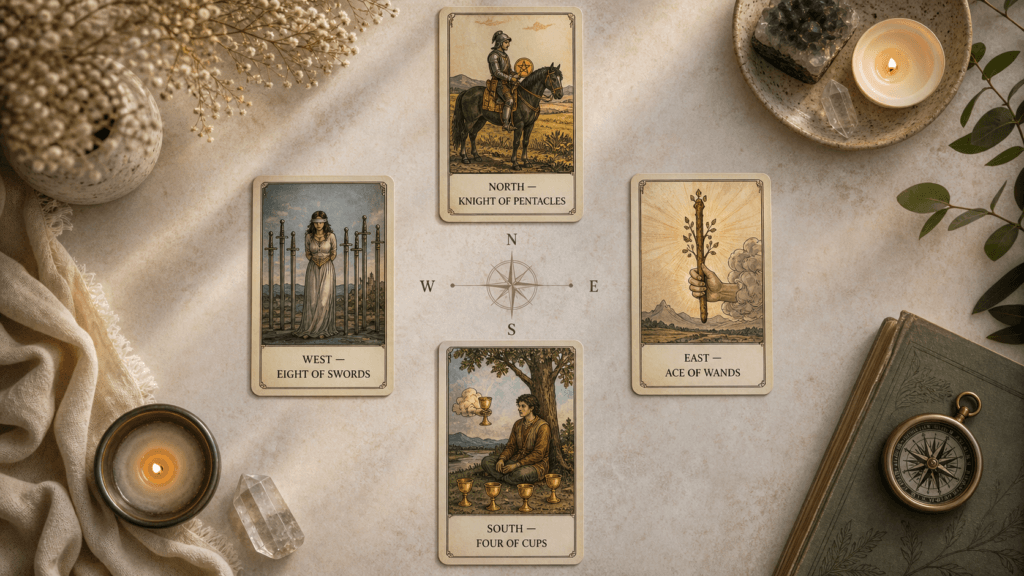
- South: Four of Cups
- West: Eight of Swords
- East: Ace of Wands
- North: Knight of Pentacles
That would suggest a fairly recognisable moment. The Four of Cups in South can point to emotional flatness, withdrawal, or a sense that nothing in front of you feels quite right. In West, the Eight of Swords may show a limiting story you have been living inside for too long, one that is beginning to lose its authority. East, with the Ace of Wands, suggests that something new is trying to come through. North, with the Knight of Pentacles, does not promise instant transformation. It points to steadiness, routine, and doing the next workable thing.
In other words, the spread would not be saying, “Everything is about to change overnight.” It would be saying, “The fog is lifting, but your way forward is probably simple, grounded, and consistent.”
When this spread helps most
This spread is especially useful when:
- You feel emotionally scattered.
- You are between one phase of life and the next.
- You need perspective more than prediction.
- You want to make a decision without forcing clarity too quickly.
It is also a good spread for beginners. There is enough structure to keep the reading focused, but not so much that the message gets buried under too many positions.
If you want something even simpler, try the 3-card tarot spread. It is a good next step when you want a lighter reading with less structure.
A few practical notes
Try not to ask the spread to solve your whole life in one sitting. A smaller question usually gives a cleaner answer.
It also helps to stay close to the position before rushing into symbolism. A card in North reads differently than the same card in West. Direction shapes meaning.
If one card feels unclear, leave it alone for a minute and read the others first. Very often the relationship between the cards will explain the one that seemed hardest to understand.
If you want a more detailed reading, you may prefer the Celtic Cross tarot spread. It gives you more room for nuance when the question is complex.
Frequently Asked Questions
Is the compass tarot spread good for beginners?
Yes. It is one of the more approachable direction-based spreads because each position is clear and distinct.
Do I need to read reversals?
No. If reversals are already part of your practice, you can include them. If not, this spread works perfectly well without them.
Is this a prediction spread?
Not really. It is better used for guidance and orientation than for fixed outcomes.
What if the North card feels too vague?
Treat it as advice, not a command. Sometimes the next step is concrete, and sometimes it is more about attitude, pacing, or what to stop resisting.
Ready to pull your cards? If you need help deciphering your reading, explore our complete guide to all 78 tarot card meanings to find your direction.