
Yes or No Tarot Reading: A Simple Guide to Getting Clear Answers

Disclaimer: This post contains affiliate links. If you make a purchase through them, we may earn a small commission at no extra cost to you.
Sometimes you don’t need a ten-card spread or a deep dive into your shadow self. You just need an answer. That’s exactly what a yes or no tarot reading is for — a quick, honest way to check in with the cards when a question is sitting heavy on your mind and you want something more direct than a full reading can offer.
What a Yes or No Tarot Reading Actually Does
Before we get into methods, it helps to set expectations. A Yes or No reading doesn’t predict a fixed future the way a weather forecast might. What it does is reflect the energy around your question right now — whether things are flowing in your favor, meeting resistance, or sitting in a kind of holding pattern.
That distinction matters. If you treat every card as a locked-in verdict, you’ll end up frustrated when life doesn’t match the answer exactly. If you treat it as a read on current momentum, the cards become a lot more useful.
How a Yes or No Tarot Reading Works
If tarot doesn’t offer a fixed weather forecast of the future, how does drawing a random piece of cardboard actually give you a valid “yes” or “no”?
A Yes or No reading works through a combination of synchronicity and psychological mirroring. From a spiritual perspective, the cards act as a bridge to your intuition, picking up on the unseen energetic momentum of your current situation. You draw the card that accurately reflects the frequency of the path you are currently walking.
From a psychological standpoint, a Yes or No pull is incredibly revealing because of how you react to it. If you ask the cards a question, draw a “No,” and immediately feel a pang of disappointment or an urge to draw another card, the reading has already worked. It instantly bypassed your conscious overthinking and revealed that deep down, you actually wanted a “Yes.” The cards don’t dictate your path; they hold up a mirror so you can see your own truth more clearly. If you want to experience this clarity right now, you can try our Free Yes or No Tarot Reading to get immediate insight into your situation.
Three Ways to Ask a Yes or No Question
There’s no single “correct” method here. Most readers settle on one of these three, depending on how much nuance they want.
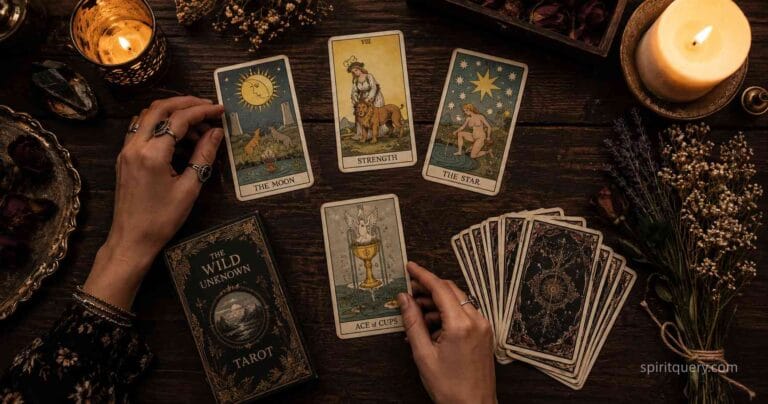
The single-card pull. Shuffle, ask your question out loud or in your head, and draw one card. Upright generally leans yes, reversed generally leans no. It’s the fastest method and the easiest for beginners, though it leaves the least room for context.
The three-card pull. Draw three cards instead of one. If most of them lean upright, the answer leans yes. If most lean reversed, it leans no. A card that sits in the middle — neither strongly upright nor reversed in meaning — often signals that the timing isn’t right yet, not that the answer is a hard no.
Reading by card meaning, not orientation. Some readers skip reversals altogether and instead sort cards by their traditional meaning. Cards like The Sun, The Star, or the Ace of Wands tend to read as yes regardless of orientation. Cards like The Tower, Death, or The Devil tend to read as no or at least “not like this.” This method takes more familiarity with the deck, but it avoids the ambiguity that reversals can sometimes introduce.
Try one method consistently for a while before switching. Jumping between systems on the same question is usually what makes a reading feel unreliable.
Examples of Good Yes or No Tarot Questions
Instead of asking vague questions, try framing them like this for the most accurate yes or no tarot readings:
- Career: Will this specific project bring me financial growth this month?
- Love: Is taking a step back the best way to handle this relationship right now?
- Life: Should I focus my energy on this new opportunity this week?
When the Answer Isn’t Yes or No
This is the part a lot of guides skip, and it’s probably the most important part. Tarot doesn’t always hand you a clean binary. Sometimes what you get is closer to “yes, but not yet” or “no, unless something changes.”
A card like The Hanged Man rarely means a flat no — it usually means pause, wait, look at this from another angle. The Wheel of Fortune might mean yes, but on a timeline outside your control. Learning to sit with that in-between space is part of what makes a reading feel honest rather than forced.
If your draw feels contradictory, that’s not a failure. It’s usually a sign the question itself needs to be asked more specifically.
The Ultimate Tarot Cards Yes or No List (Major Arcana)
Here’s a general reference for how the 22 Major Arcana cards tend to read in a Yes or No context. Treat this as a starting point, not gospel — your own intuition and the context of your question always matter more than a table.
| Card | General Answer |
|---|---|
| The Fool | Yes, but be prepared to improvise |
| The Magician | Yes |
| The High Priestess | Maybe — trust your intuition over logic here |
| The Empress | Yes |
| The Emperor | Yes, with structure and effort |
| The Hierophant | Yes, with traditional support |
| The Lovers | Yes |
| The Chariot | Yes, through determination |
| Strength | Yes, if you stay patient |
| The Hermit | No, not right now — more reflection needed |
| Wheel of Fortune | Yes, but timing is out of your hands |
| Justice | Yes, if you’re honest and fair |
| The Hanged Man | No, or not yet |
| Death | No, this needs to end first |
| Temperance | Yes, but patience is required |
| The Devil | No |
| The Tower | No, expect disruption |
| The Star | Yes |
| The Moon | No, clarity is missing right now |
| The Sun | Yes |
| Judgement | Yes, after reflection |
| The World | Yes, after reflection |
Common Mistakes People Make
Asking the same question over and over. If you don’t like an answer, drawing again five minutes later usually just adds noise. Give it time — days, not minutes — before you ask again.
Phrasing questions too vaguely. “Will things work out?” is hard for any method to answer well. “Will this specific opportunity move forward in the next few weeks?” gives the cards something to actually respond to.
Ignoring the card’s meaning in favor of the orientation alone. A reversed card on a naturally difficult card, like the Tower, doesn’t automatically flip to a strong yes. Context still matters.
Frequently Asked Questions
Is a Yes or No tarot reading accurate?
It depends on what you mean by accurate. It won’t predict specific events with certainty, but it’s genuinely useful for reflecting the energy and likely direction of a situation. Treat it as guidance, not prophecy, and it holds up well.
Can I ask the same question twice?
You can, but it’s better to wait. Asking again right away usually just muddies the read rather than clarifying it.
What if the cards seem to contradict each other?
That’s common with the three-card method. It often means the answer is conditional — yes if something changes, or no for now but not permanently. Don’t force it into a clean binary if it doesn’t want to be one.
Does a reversed card always mean no?
Not always. Some cards, like The Hermit or The Moon, carry ambiguous energy even upright. Reversal shifts the tone, but the card’s core meaning still matters more than orientation alone.
Ready to try it yourself? Do a quick yes or no tarot reading now and see what the cards have to say.