The 3-Card Tarot Spread: A Beginner’s Guide to Reading with Three Cards

Disclaimer: This post contains affiliate links. If you make a purchase through them, we may earn a small commission at no extra cost to you.
I’ve done readings with ten cards, twelve cards, full Celtic Crosses that took up half my kitchen table. But when I need the truth fast, I still come back to the 3-card tarot spread more than anything else.
Not because it’s the easy option. Because three cards tell the truth fast. There’s nowhere to hide when you only have three positions — no card to blame the confusion on, no “well maybe this one cancels that one out.” You pull three cards, you sit with them, and the story either makes sense or it makes you uncomfortable. Either way, you learn something.
Let’s skip the 10-card Celtic Cross for today. Here is exactly how I use just three cards to get brutal, honest answers when I’m short on time. If you want to pull your own cards while you read this, you can try a free 3-card tarot reading right now — no need to grab a physical deck.
What is a three card tarot reading?
A spread is just a structure. Each position in the layout stands for something specific — a time frame, a perspective, an area of your life — and you assign those meanings before you pull any cards.
That’s the part people skip when they’re new to this. They pull three cards and then try to figure out what each one “means.” But without a position to anchor it, a card is just floating. The Three of Swords by itself could mean grief, or a hard truth, or the end of mental confusion. In a Past position, it’s telling you where you came from. In a Future position, it’s a warning. Same card, completely different reading — because of where it lands.
The 3-card spread hits a sweet spot that larger spreads don’t:
- Focused enough to actually answer a question (unlike a single card, which often just raises more)
- Simple enough to do in ten minutes without losing the thread
- Flexible enough to work for anything — a quick daily check-in, a relationship question, a decision you’ve been avoiding
It’s also the best spread for learning how to connect cards rather than just identify them. That skill — reading cards in relationship to each other — is what separates someone who knows tarot from someone who can actually read it.
The classic three card tarot reading: Past, present & future
This is the one most people learn first, and there’s a reason it’s stuck around. A timeline is the most natural way to understand a situation: how you got here, where you are, where you’re headed.
Card Positions:
Position 1 — Past
This card isn’t asking you to dig up ancient history. It’s pointing at whatever is most relevant to your question — usually something from the last few weeks or months. A pattern that started it. A decision that set things in motion. An energy you’ve been carrying without realizing it.
Sometimes this card shows something obvious, something you already knew was part of the story. Other times it names something you’d been trying not to look at. Both are useful.
Position 2 — Present
Where you actually are right now — not where you wish you were, not where you’re trying to get to. Your current mindset, the energy around you, what’s actively in play.
A lot of readers find this is the card they react to most strongly, whether that’s recognition (yes, that’s exactly it) or resistance (no, that can’t be right). If you feel yourself wanting to dismiss the present card, that’s worth sitting with. The deck isn’t always telling you what you want to hear.
Position 3 — Future
This is the most misunderstood position in the spread. It’s not a prophecy. It’s a projection — the most likely outcome based on the energy that’s already in motion. Think of it as where your current trajectory is pointing.
If you don’t like what you see here, that’s the whole point. The reading is showing you something you can still change.
How to Read the Three Cards Together
Reading each card one by one and then stopping is like describing three separate puzzle pieces without ever fitting them together. The meaning lives in the connection.
Here’s what actually works:
- Flip all three before you interpret any of them. Get a feel for the overall picture first — are you looking at mostly Major Arcana (big life themes) or Minor Arcana (day-to-day stuff)?
- Find the arc. What’s the shape of the story? Is it moving from dark to light, or the other way?
- Look for tension. Does card 3 echo card 1, like you’ve come full circle? Does card 2 interrupt the flow?
- Say it out loud. Literally speak the story: “I came from [card 1], I’m currently in [card 2], and if nothing changes I’m moving toward [card 3].”
How to do a 3 card tarot reading: 5 variations to try
The Past, Present, Future is just the beginning. Here are five variations to use when a different kind of clarity is needed.
| Spread | Card 1 | Card 2 | Card 3 |
|---|---|---|---|
| Situation, Challenge, Advice | Card 1 What’s happening right now | Card 2 What’s blocking or complicating it | Card 3 What to do about it |
| Mind, Body, Spirit | Card 1 What your mind is focused on | Card 2 What your body or physical life needs | Card 3 What your spirit is calling you toward |
| Option A / Option B / What to Know | Card 1 Energy of the first choice | Card 2 Energy of the second choice | Card 3 An unseen factor affecting both |
| Embrace, Release, Next Step | Card 1 An energy worth leaning into | Card 2 Something to let go of | Card 3 The natural next move |
| How They Feel, What Stands Between You, Outcome | Card 1 The other person’s emotional state | Card 2 The obstacle in the connection | Card 3 Where the relationship is heading |
Which spread should you choose?
- Use Situation, Challenge, Advice when you want concrete guidance on a problem.
- Use Mind, Body, Spirit for a general wellness check-in.
- Use Option A / Option B when you’re deciding between two real choices.
- Use What to Embrace, What to Release at the start of a new month or season.
- Use How They Feel, What Stands Between You for relationship questions — it avoids the vague “will we get together?” and instead maps the actual dynamics at play. For a full set of love and relationship spreads covering every stage, see our Love & Relationship Tarot Spreads guide.
Tarot three cards reading: Step by step guide
Step 1: Set Your Intention
Before you shuffle, get clear on what you’re asking. Vague questions get vague answers. Instead of “what’s going on with my life?”, try something like “what do I need to understand about my current situation at work?”
Good questions for a 3-card spread:
- “What led me here, where am I now, and where is this heading?”
- “What should I embrace, release, and act on this month?”
- “What is the energy around [specific decision]?”
Step 2: Shuffle the Cards
There’s no single correct way to shuffle tarot. The most important thing is that you’re thinking about your question the entire time. Common methods:
- Overhand shuffle — the most familiar, great for beginners
- Riffle shuffle — quicker, but be gentle with older decks
- Pile shuffle — splitting into three piles and recombining
- Spreading and pulling — fanning cards face-down and intuitively selecting three
Shuffle until it feels right. Some readers shuffle until a card “jumps out.” Others shuffle for a set number of times. Follow what resonates.
Step 3: Lay the Cards
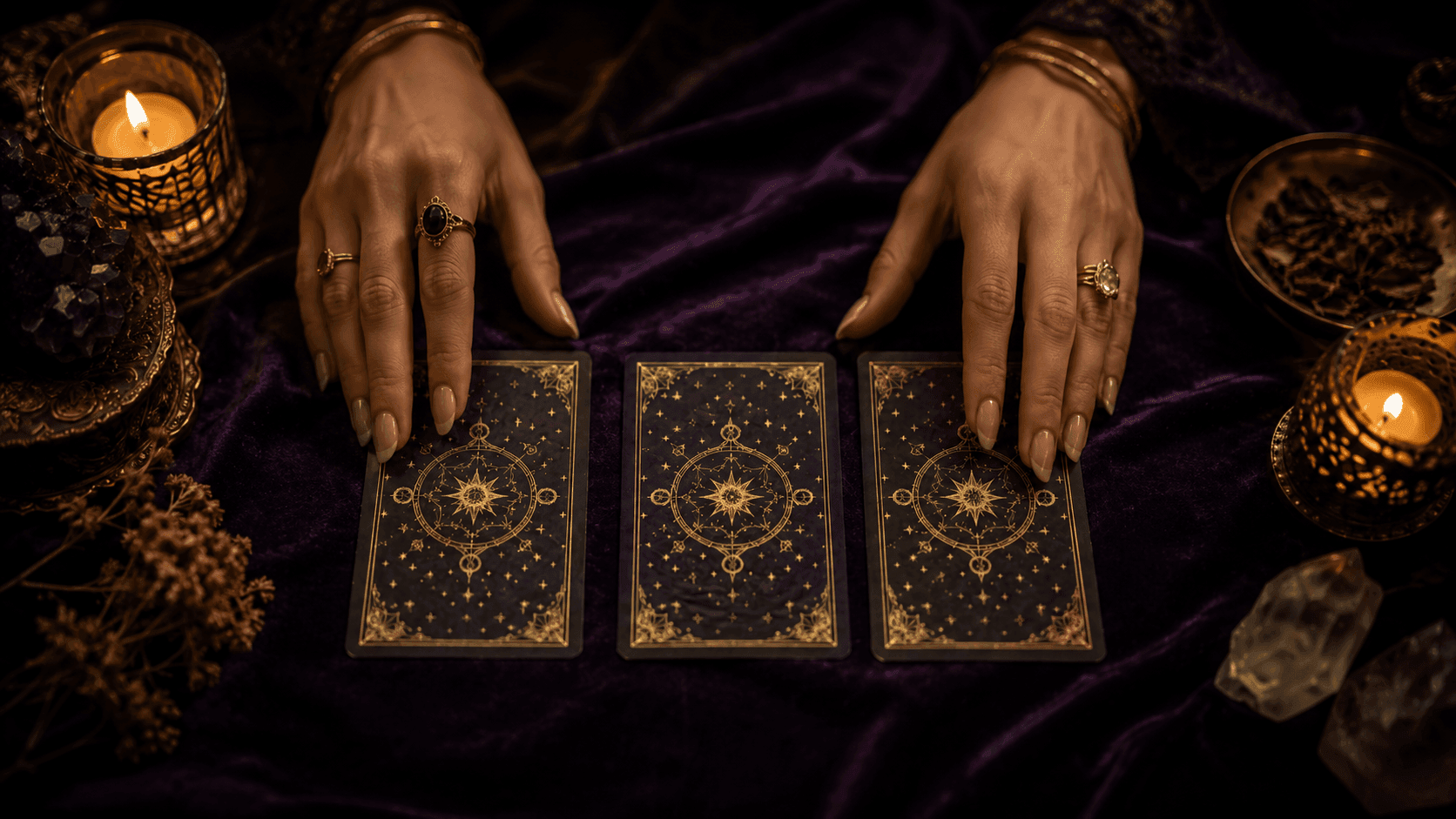
Place three cards face-down in a row, left to right. Position 1 is always on the left (past), position 2 in the middle (present), position 3 on the right (future) — or whatever layout you’ve chosen.
Some readers flip all three at once. Others reveal one at a time. Try both and see which helps you focus. If you don’t have a deck on hand, our free 3-card tarot reading tool shuffles and lays out the cards for you in this exact layout.
Step 4: Read Each Card in Its Position
Start with card 1 and consider: what does this card mean in this specific position? Don’t just recite the card’s general meaning — actively connect the card to what the position is asking.
If you pulled The Tower in the Past position, you’re not predicting a current disaster — you’re looking at a shake-up that already happened, and what that cleared away.
Step 5: Weave the Story
Once you’ve considered each card individually, zoom out. Use the narrative method from the “How to Read the Three Cards Together” section above. Write it down if you can — even a few sentences in a tarot journal makes the meaning stick, and you’ll be amazed how accurate readings look in hindsight.
A Real Reading Example
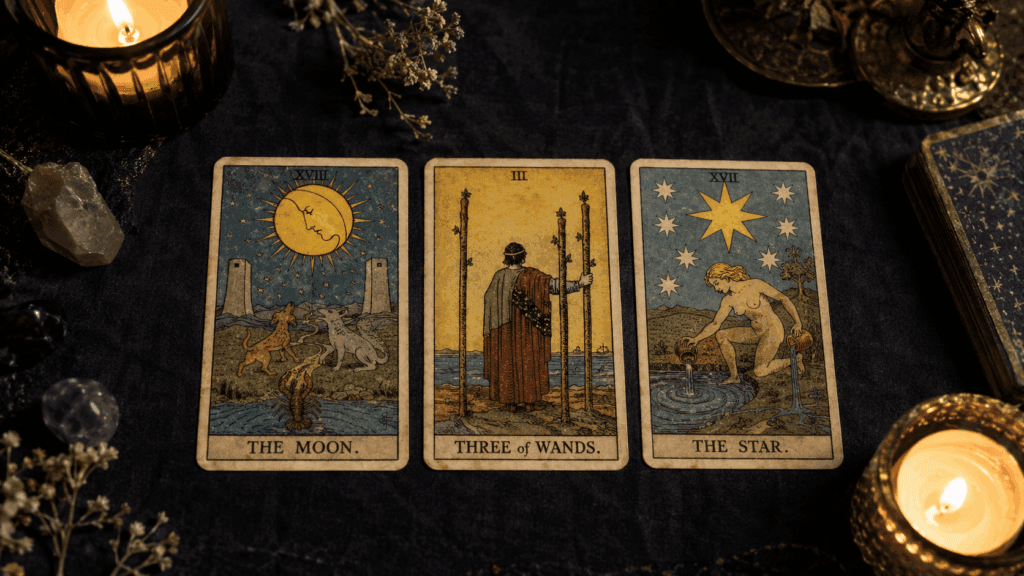
Question: “What do I need to know about starting my own business?”
Cards drawn:
- Past → The Moon — uncertainty, fear, things not being as they appear
- Present → Three of Wands — looking ahead, planning, early momentum
- Future → The Star — hope, recovery, clarity after difficulty
Reading:
When I first flipped the cards and saw The Moon, my immediate thought was, “Ouch, that explains a lot.” The Moon in the Past position tells us that the lead-up to this decision was marked by confusion — maybe self-doubt, maybe unclear information, or a situation where not everything was visible. There was a reason this decision felt hard to make.
But then looking at the Three of Wands in the Present position—the visual shift is huge. The guy on this card is standing on a cliff, looking out at the ocean. The fog of The Moon is totally gone. Three of Wands in the Present is a strong signal: the fog is clearing. You’ve done the groundwork, you can see the horizon, and you’re in the active planning phase. This isn’t wishful thinking — there’s real forward motion here.
The Star as the Future outcome is encouraging. It suggests that if you keep going, you’ll move into a phase of renewed clarity and genuine optimism. After the confusion of The Moon, The Star says: this will start to feel lighter. However, remember that The Star is a quiet, healing energy—it doesn’t promise you’ll be a millionaire overnight. It just means the path forward will finally feel authentic.
The arc: Fear and uncertainty → active planning and growing confidence → clarity and hope ahead.
Internal links to explore:
Tips for Getting the Most Out of Your Reading
Ask better questions
The quality of your reading depends heavily on what you ask. Avoid yes/no questions (save those for a Yes or No spread) and questions that give away your agency (“will he come back?”). Instead, ask questions that keep you in the driver’s seat: “What do I need to understand about this situation?” or “What action would most support my growth right now?”
Decide your position on reversals before you start
Reversed cards (upside-down) can add nuance to a reading, but they also double the interpretive work. As a beginner, it’s perfectly valid to read all cards upright and focus on mastering the core meanings first. If you do read reversals, decide your approach before shuffling — don’t change course mid-reading.
Keep a tarot journal
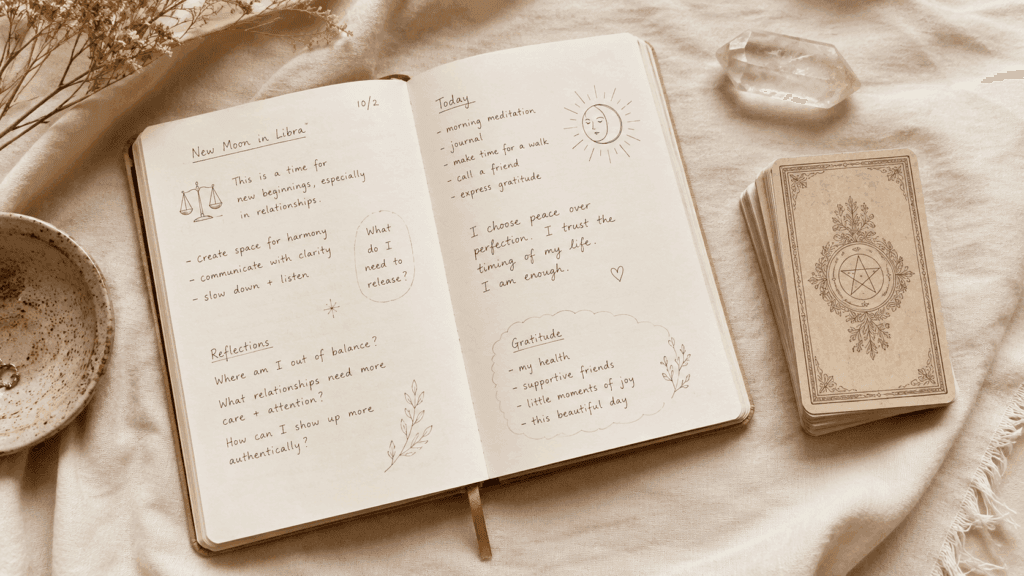
Write down your three cards, your question, the date, and what the reading meant to you. Then come back a week or a month later. Over time, you’ll notice patterns in which cards appear at certain life moments — and your accuracy at interpreting them will improve dramatically. Even a simple notes app works.
Trust your intuition over the book definition
Card meaning guides (including this one) are starting points, not scripts. If you pull the Five of Cups and immediately think of a specific person or situation before you’ve consciously interpreted anything — that’s your intuition doing the work. Note it. Card definitions provide a framework; your lived experience provides the meaning.
Frequently Asked Questions
How to do a 3 card tarot reading for everyday situations?
The most effective everyday tarot three cards reading is the “Situation, Challenge, Advice” layout. It doesn’t try to predict the future; instead, it clarifies what is happening right now, pinpoints the specific obstacle blocking you, and gives you actionable advice on what to do next.
Can I use a three card tarot reading for love?
Yes. Instead of the standard past-present-future timeline, use a specialized relationship three card tarot reading: Card 1 for their current emotional state, Card 2 for the core obstacle between you, and Card 3 for where the connection is heading. This provides a much more honest answer than just asking if they like you.
Is a three card tarot reading better than a one tarot card reading?
They serve different purposes. A one tarot card reading is excellent for a quick daily focus or building an intuitive connection with a new deck. A three card tarot reading, however, introduces narrative and context, allowing you to see the trajectory of a situation (like past-present-future) rather than just a static snapshot.
Want to see this in action? Draw your free 3-card tarot reading and read your own past, present, and future right now.
Ready to go deeper? Learn how to read the Celtic Cross Tarot Spread — the most comprehensive 10-card layout in traditional tarot.