The Complete Guide to the Suit of Swords: Mastering Tarot’s Mental Realm

Disclaimer: This post contains affiliate links. If you make a purchase through them, we may earn a small commission at no extra cost to you.
What Suit of Swords Meanings Actually Reveal
I’ll be direct: most people hate pulling Swords cards. They see the imagery—someone bound and blindfolded, hearts pierced, figures lying face-down with ten blades in their back—and assume the worst.
Here’s what eight years of reading tarot professionally has taught me: the Swords aren’t cruel. They’re honest. And honesty, especially about our thoughts and the stories we tell ourselves, can hurt worse than any physical wound.
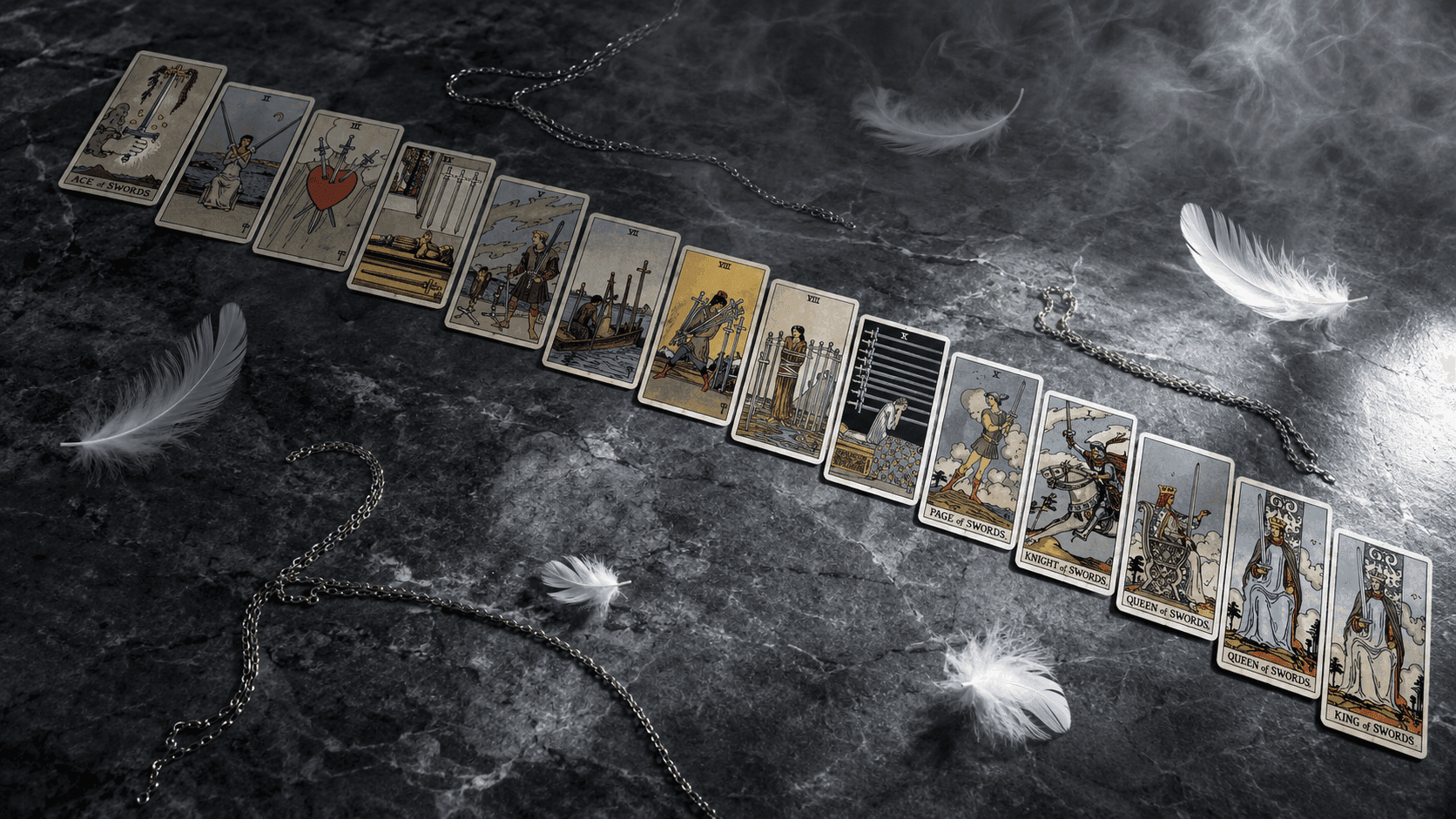
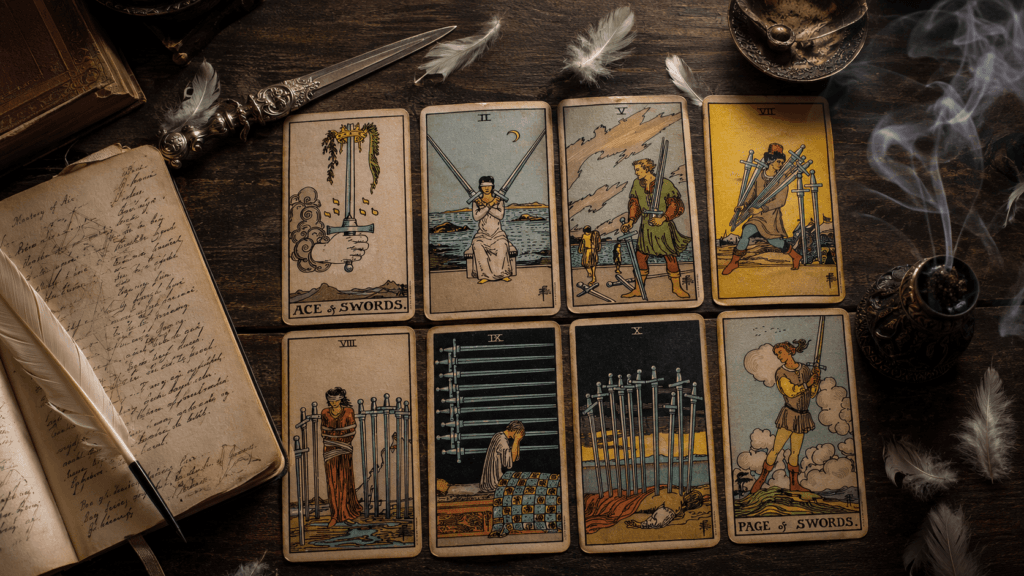
The Suit of Swords contains 14 cards—Ace through Ten, plus four court cards. Together, they map the entire mental and intellectual landscape: clarity and confusion, truth and deception, conflict and resolution, anxiety and breakthrough.
If you keep pulling Swords cards, your mind is trying to tell you something. This guide will help you hear it.
Why Air? Understanding the Element
Every tarot suit corresponds to a classical element. Swords represent air—the realm of thought, communication, logic, and truth.
Air moves fast. It can be a gentle breeze or a devastating storm. It carries messages, disperses fog, and cuts through illusion. But it can also scatter your focus, freeze you with analysis paralysis, or trap you in endless mental loops.
In readings, the air element shows up as:
- Thoughts that won’t stop circling (the 3 AM anxiety spiral)
- Communication—what you say, what you don’t say, what gets misunderstood
- Mental clarity that cuts through confusion like a blade
- Conflict, both internal (self-doubt) and external (arguments, legal battles)
- Truth-seeking, even when the truth is uncomfortable
- Intellectual breakthroughs and “aha” moments
The Swords don’t care about your feelings. They care about what’s true, what’s being said (or left unsaid), and whether your thoughts are serving you or sabotaging you.
What Swords Actually Govern (Beyond “Conflict and Pain”)
Yes, Suit of Swords meanings rule conflict and difficult truths. But reducing them to “the bad news suit” misses their power. Here’s what I’ve seen Swords cards address in actual readings:
Mental Clarity & Decision-Making
The Ace of Swords is breakthrough clarity—the moment everything suddenly makes sense. The Two of Swords is decision paralysis, refusing to look at the truth because both options hurt.
Communication & Truth-Telling
The King of Swords says what needs to be said without cruelty. The Seven of Swords is strategic silence—or outright deception.
Anxiety & Overthinking
The Nine of Swords is the tarot’s anxiety card. When it appears, you’re not dealing with actual danger—you’re dealing with the stories your mind is telling about danger.
Endings & Necessary Losses
The Ten of Swords looks brutal, but it represents the end of suffering. What’s over is over. The blade can’t wound you twice.
Justice & Legal Matters
Swords appear in readings about contracts, legal disputes, divorce proceedings, and any situation where objective truth matters more than subjective feeling.
Reading Swords Cards: What to Actually Look For
Here’s the key most beginners miss: Swords show you your thoughts about reality, not reality itself.
The Direction the Sword Points
Is it pointed up (offensive, assertive, cutting through) or down (defensive, protective, grounded)? Is it held firmly or about to drop?
The Figure’s Eyes
In the Two of Swords, she’s blindfolded—refusing to see. In the Eight of Swords, she’s bound and blindfolded—but the bindings are loose. She could remove them if she realized.
In the Nine of Swords, the person sits upright in bed, hands covering their face. The swords hang on the wall behind them—they’re not real threats. They’re in her mind.
Sky Conditions Matter
Swords often show turbulent skies, storm clouds, or harsh light. This isn’t decoration—it’s the mental weather you’re experiencing.
All 14 Swords Cards: Meanings That Actually Help
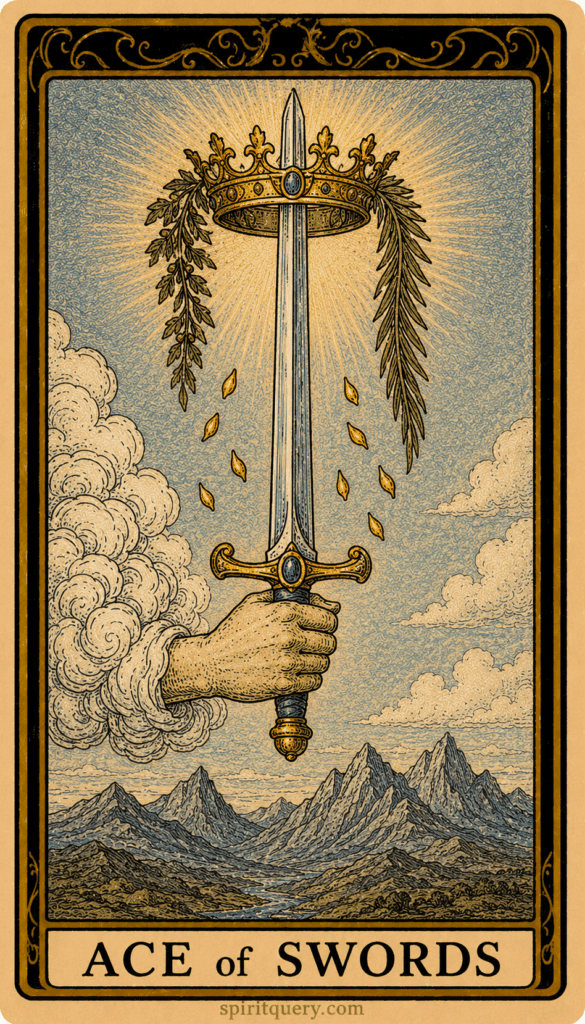
Ace of Swords
Keywords: Breakthrough, mental clarity, truth revealed, new perspective, cutting through confusion
A hand emerges from a cloud, holding an upright sword crowned with a wreath. The blade cuts through a mountain peak—nothing can stand in the way of this clarity.
What it actually means in readings:
This is the “aha” moment. The fog lifts. You suddenly see the truth you’ve been avoiding, the solution you’ve been missing, or the lie you’ve been believing.
The Ace of Swords appears before major decisions, legal victories, difficult but necessary conversations, and moments when you finally understand what’s really going on.
Watch out for: Clarity without compassion can be brutal. The sword cuts through illusion, but it also cuts through connection if you’re not careful. Truth matters, but so does timing and tone.
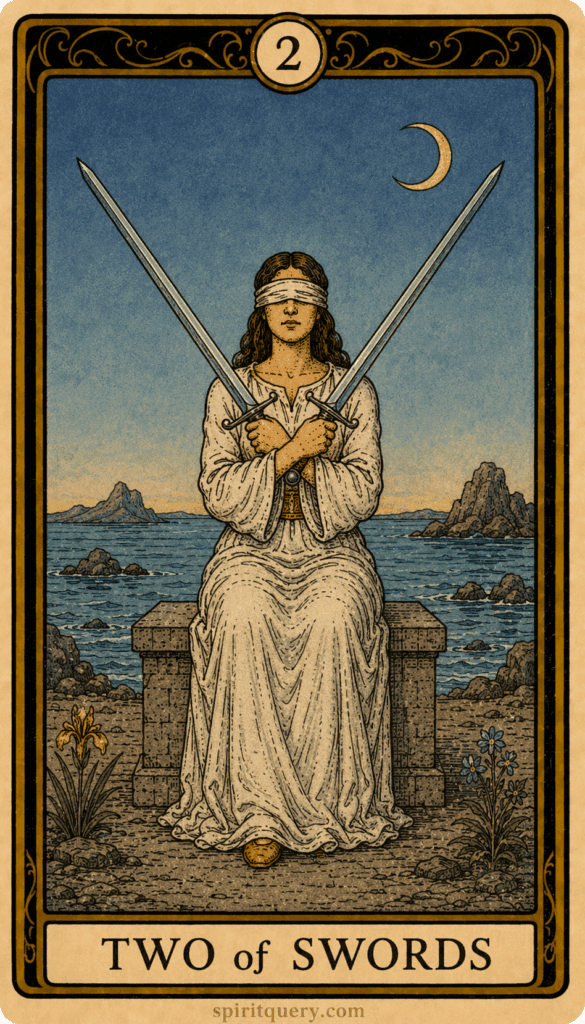
Two of Swords
Keywords: Difficult decision, avoidance, stalemate, refusing to see, temporary peace through denial
A blindfolded figure sits with arms crossed, holding two swords in perfect balance. Behind her, a crescent moon rises over choppy waters.
What it actually means in readings:
You’re stuck between two choices, both painful. So instead of choosing, you’ve decided not to look at either option. The blindfold is self-imposed.
This card appears constantly in relationship readings: “Should I stay or go?” “Should I say something or stay silent?” The Two of Swords says you already know the answer. You’re just not ready to see it.
Watch out for: You can’t stay balanced on the fence forever. Eventually, not choosing is a choice—and usually the worst one.
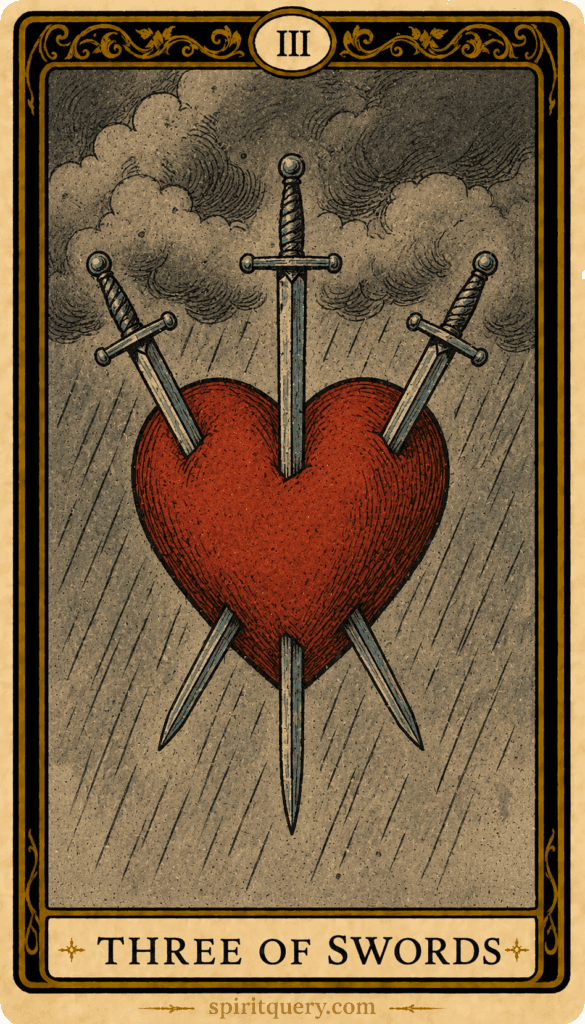
Three of Swords
Keywords: Heartbreak, painful truth, betrayal, grief, necessary sorrow, clarity through pain
A heart floats in a storm, pierced by three swords. Rain falls. There’s no escaping this image’s meaning.
What it actually means in readings:
Something you believed has been shattered. A truth has been revealed that hurts. This is the card of breakups, betrayals, discovering lies, or realizing something you hoped for isn’t going to happen.
But here’s what people miss: the Three of Swords isn’t the betrayal itself. It’s the clarity that comes from finally seeing the truth. The pain is real, but so is the liberation of no longer living in denial.
Watch out for: This card marks the moment the truth hits, not the long recovery that follows. Feel it fully, but don’t live here.
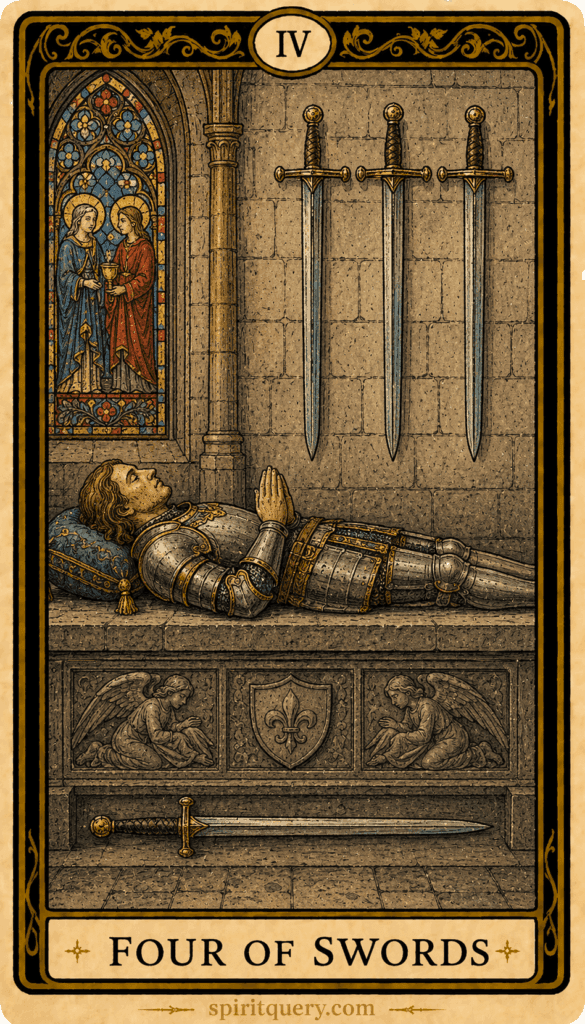
Four of Swords
Keywords: Rest, recovery, mental retreat, meditation, strategic pause, necessary timeout
A figure lies in repose, hands in prayer position. Three swords hang on the wall; one lies beneath the resting figure. The stained glass window shows a blessing.
What it actually means in readings:
Your mind needs rest. You’ve been thinking too much, worrying too much, fighting too much. This card is a prescription for mental recuperation.
I see this card with burnout, after intense mental work, before big decisions that require clarity, or when someone’s anxiety has them completely exhausted.
The Four of Swords isn’t giving up—it’s strategic withdrawal. Fighters rest between rounds. So should you.
Watch out for: There’s a difference between necessary rest and hiding. Rest, then return. Don’t mistake this for the Two of Swords’ avoidance.
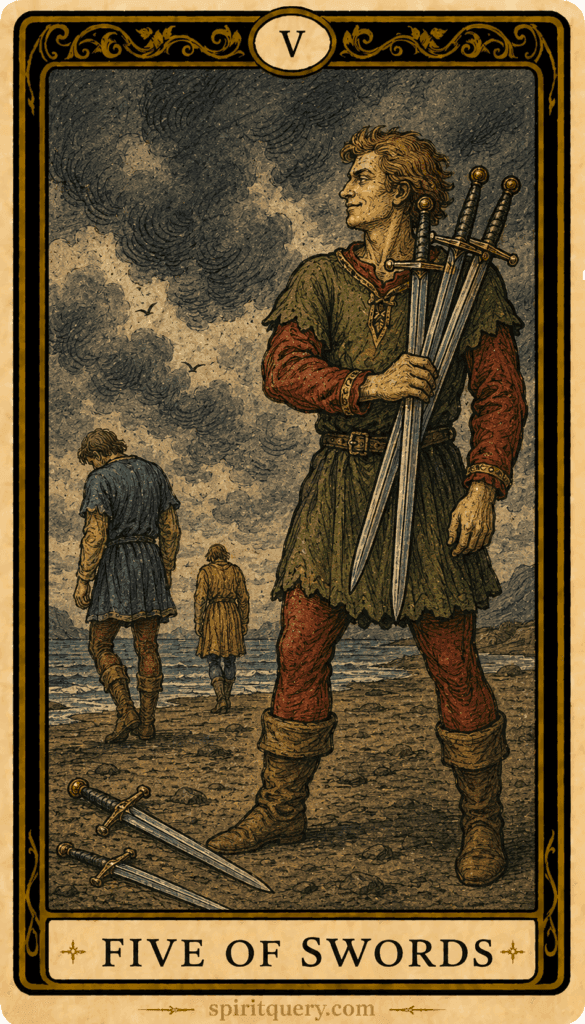
Five of Swords
Keywords: Hollow victory, conflict, defeat, winning at any cost, toxic argument, walking away
A figure holds three swords with a smirk while two others walk away, defeated. Two more swords lie on the ground. The sky is turbulent.
What it actually means in readings:
You won the argument but lost the relationship. Or you’re the one walking away from a battle that can’t be won.
This card shows up in toxic workplaces, relationships where someone always has to be right, family conflicts with no resolution, and situations where pride matters more than peace.
The central question: Is being right worth being alone?
Watch out for: Sometimes walking away is wisdom. Sometimes it’s cowardice. Sometimes fighting is necessary. Sometimes it’s ego. The Five of Swords asks you to know the difference.

Six of Swords
Keywords: Transition, moving on, mental shift, recovery, leaving troubled waters, guided passage
A figure guides a boat carrying a woman and child across water. Six swords stand upright in the boat. The water ahead is calmer than the water behind.
What it actually means in readings:
You’re in transition—moving from mental chaos to mental calm, from conflict to peace, from troubled waters to smoother sailing.
This is the card of therapy working, moving to a new city for a fresh start, leaving a toxic job, or finally getting mental distance from a painful situation.
Notice: you’re bringing the swords with you. You don’t leave the lessons behind—you integrate them.
Watch out for: Transition isn’t the same as arrival. You’re not healed yet; you’re healing. The water ahead is calmer, not calm.
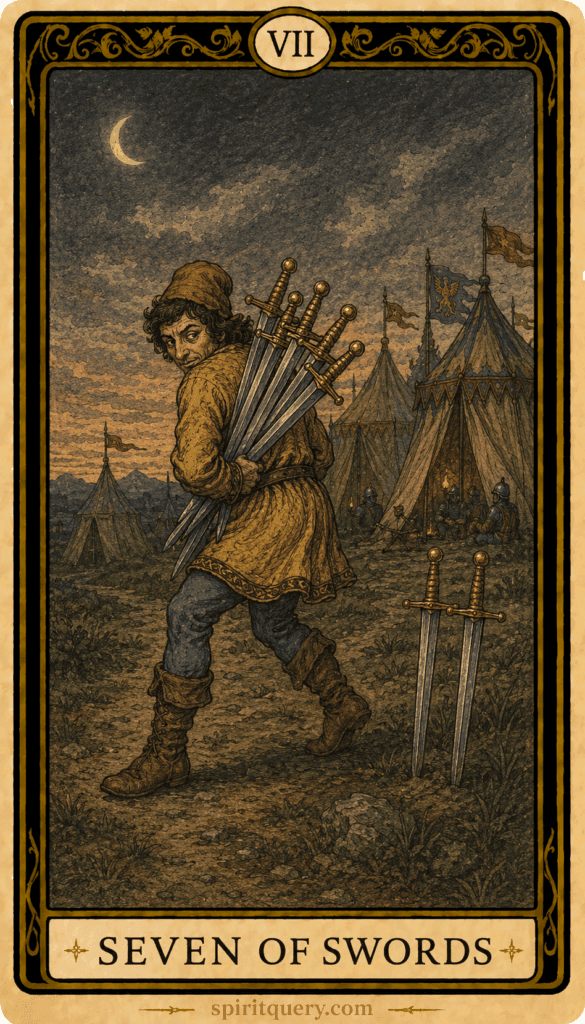
Seven of Swords
Keywords: Deception, strategy, sneaking, half-truths, clever escape, stealing away, solo mission
A figure tiptoes away from a camp, carrying five swords awkwardly while leaving two behind. They glance back with a sly expression.
What it actually means in readings:
Someone is being strategic with the truth. That someone might be you.
This card appears in workplace politics, passive-aggressive relationships, situations where you’re not lying but you’re not being fully honest either, and times when you’re quietly planning your exit.
Sometimes the Seven of Swords is necessary strategy—getting yourself out of a bad situation without causing a scene. Sometimes it’s cowardice or deception.
Watch out for: The figure is carrying five swords but leaving two. You can’t take everything with you when you sneak away. What are you willing to leave behind?
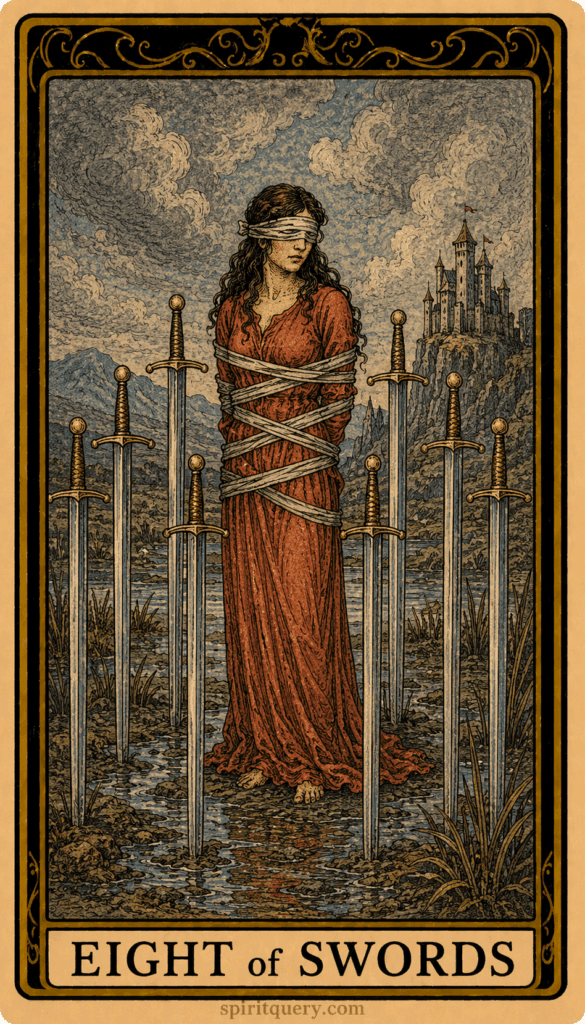
Eight of Swords
Keywords: Mental imprisonment, victim mentality, self-imposed restriction, perceived powerlessness, learned helplessness
A figure stands bound and blindfolded, surrounded by eight swords stuck in the ground. But look closely: the bindings are loose. The swords don’t form a complete cage. A path exists.
What it actually means in readings:
You feel trapped, but you’re not. The prison is mental, not physical. The bindings are loose enough to escape, but you haven’t realized it yet.
This card appears with limiting beliefs, learned helplessness, situations where “I can’t” really means “I’m afraid to,” and times when you’ve convinced yourself you have no options when you actually have several.
Watch out for: Real obstacles exist. But the Eight of Swords isn’t about real obstacles—it’s about the story you’re telling yourself about why you can’t move.
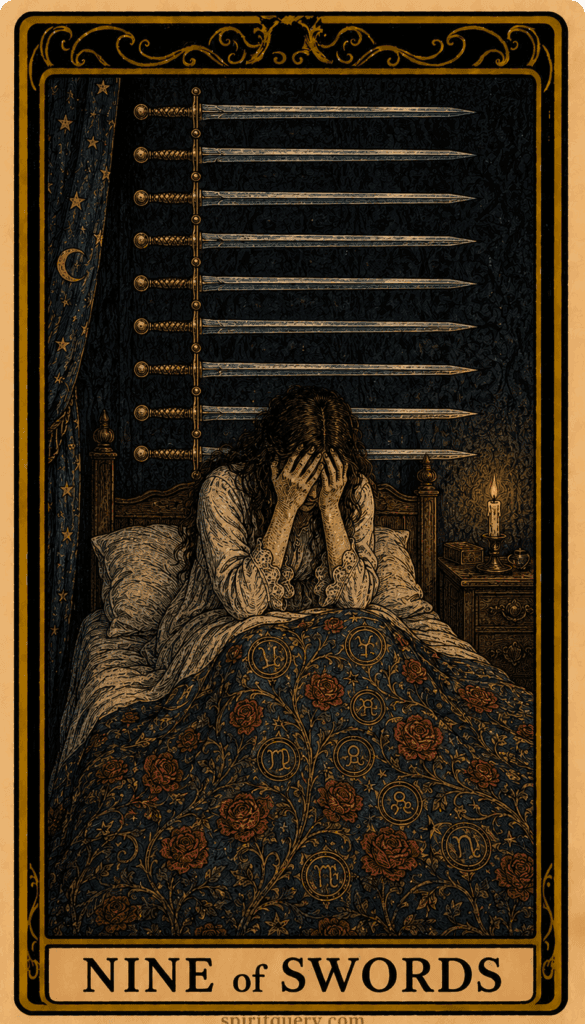
Nine of Swords
Keywords: Anxiety, nightmares, intrusive thoughts, 3 AM worry spiral, mental anguish, catastrophizing
A person sits upright in bed, hands covering their face. Nine swords hang on the wall behind them. The bed is covered in symbols of worry and grief.
What it actually means in readings:
This is the tarot’s anxiety card. The 3 AM wake-up where your mind immediately starts listing everything that could go wrong. The catastrophic thinking that spirals out of control.
Here’s the key: the swords are on the wall. They’re not stabbing the person. The danger is imagined, not actual. This is your mind torturing you with what-ifs and worst-case scenarios.
I pulled this card nightly during a period of severe anxiety. The reading wasn’t “everything is fine”—it was “your mind is creating suffering that isn’t real yet.”
Watch out for: Anxiety lies. The Nine of Swords doesn’t mean your fears are silly—it means your mind is catastrophizing beyond what’s actually happening. Separate real threats from mental what-ifs.
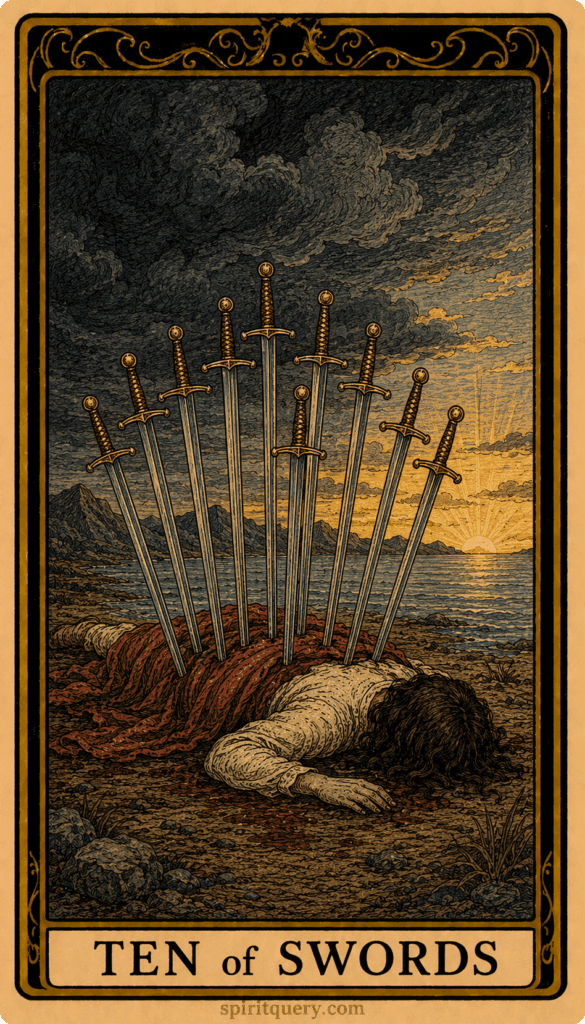
Ten of Swords
Keywords: Rock bottom, betrayal, complete ending, painful finality, can’t get worse, dawn after darkness
A figure lies face-down with ten swords in their back. The sky is black. But on the horizon, the sun is rising.
What it actually means in readings:
This is as bad as it gets. You’ve hit bottom. The worst has happened. And here’s the strange gift of the Ten of Swords: it’s over.
The same wound can’t happen twice. The relationship that ended? It’s done—no more waiting, no more false hope. The job you got fired from? You’re free to find something better. The belief you held that shattered? Now you can build a new one on truth.
Notice the sunrise. After the darkest moment comes dawn. Not immediately—but inevitably.
Watch out for: The Ten of Swords marks an ending, not ongoing suffering. If you keep pulling this card, you might be the one holding the swords in your own back, replaying the pain instead of letting it end.
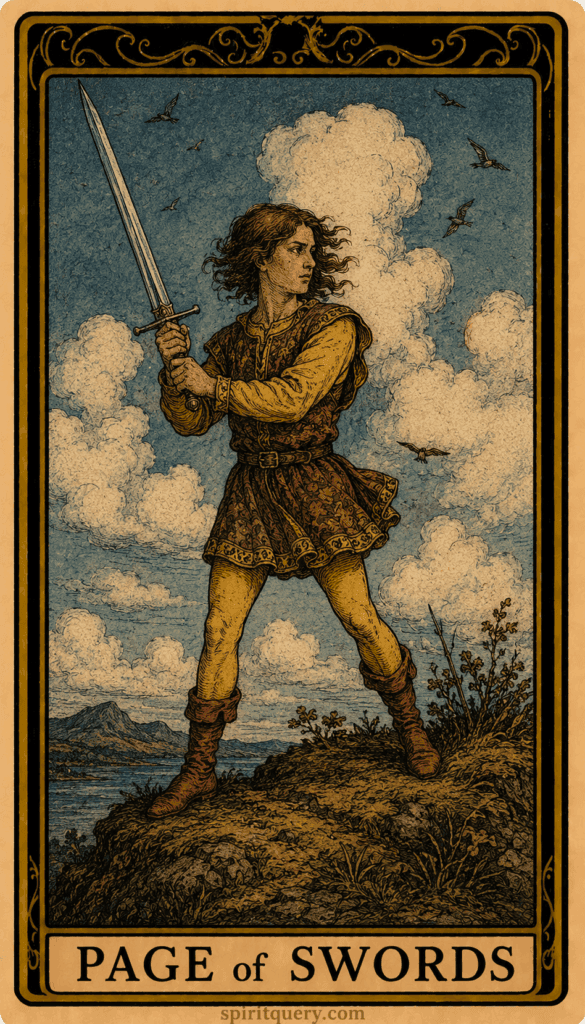
Page of Swords
Keywords: Curiosity, mental agility, vigilance, messages, new ideas, sharp tongue, intellectual beginning
A young figure stands alert, holding a sword upright. The wind blows; birds fly in formation. They’re ready for anything—perhaps too ready.
What it actually means in readings:
New ideas, sharp questions, intellectual curiosity, or a message incoming. The Page of Swords is mentally quick, alert, sometimes suspicious.
This card often represents a person—someone clever, witty, possibly sarcastic, who asks the questions no one else dares to ask. Or it’s you in “investigator mode,” digging for truth.
Pages are students. The Page of Swords is learning to think critically, communicate clearly, and wield truth like a weapon (without cutting themselves on it).
Watch out for: Pages can be immature. The Page of Swords can be argumentative for the sake of argument, clever without being wise, or so vigilant they see threats where none exist.
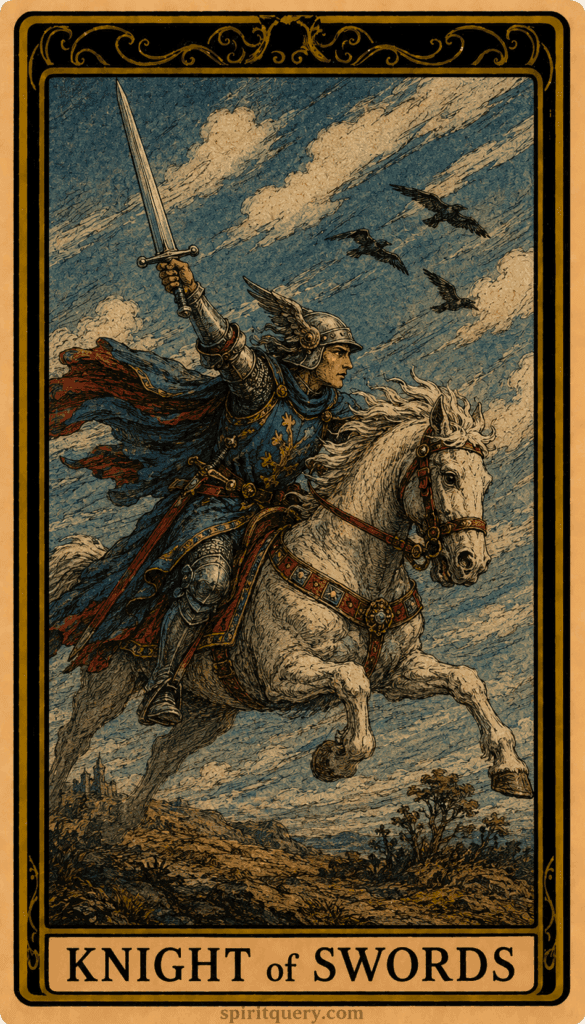
Knight of Swords
Keywords: Direct action, intellectual aggression, cutting to the point, impatience, rushing forward, tactical strike
A knight charges forward at full speed, sword raised, cape streaming behind. The clouds are turbulent. Nothing will stop this pursuit.
What it actually means in readings:
Fast action based on mental clarity. This is someone (often you) who’s figured out what needs to be done and is doing it—now—without hesitation or diplomacy.
The Knight of Swords appears before direct confrontations, hard conversations you’ve been avoiding, moments when you cut through the bullshit and say what needs to be said, or legal/intellectual battles pursued with intensity.
Watch out for: The Knight of Swords doesn’t slow down to check for collateral damage. They’re right, they’re fast, and they might run you over. Truth delivered without compassion becomes cruelty.
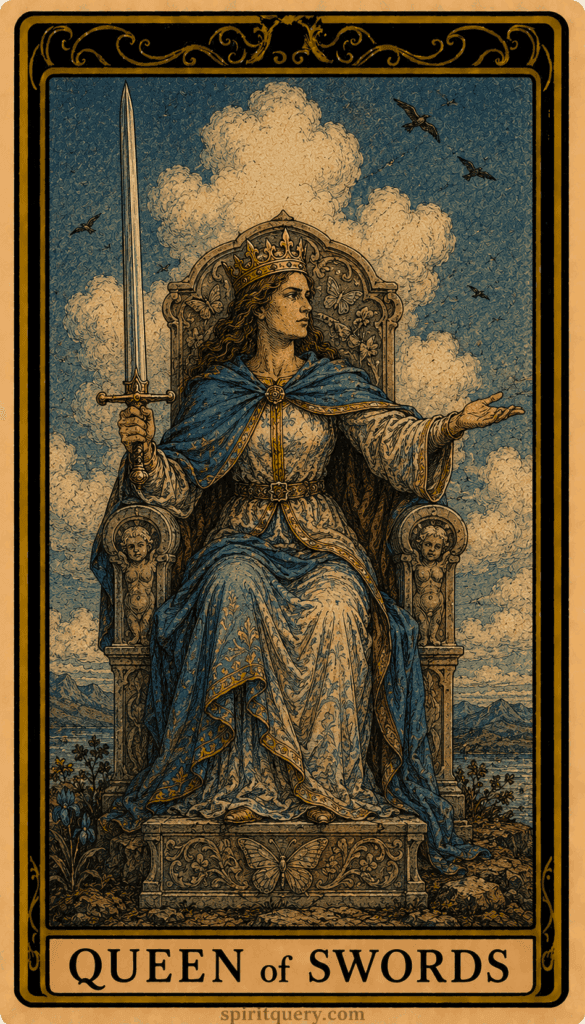
Queen of Swords
Keywords: Clear boundaries, intellectual independence, direct honesty, cutting through BS, truth-teller, discernment
The Queen sits on a throne, holding her sword upright. Her other hand is raised in a gesture that could be blessing or dismissal. The sky is clear. She sees everything.
What it actually means in readings:
This is someone who’s been through it, lost people, made hard choices, and come out with absolute clarity about who they are and what they’ll accept.
The Queen of Swords doesn’t lie to you or let you lie to yourself. She’s the friend who tells you the truth you don’t want to hear. She’s the therapist who won’t let you hide. She’s you when you’re finally done with other people’s drama.
She’s kind—but her kindness is truth, not comfort. She’ll help you see clearly, even when clarity hurts.
Watch out for: The shadow Queen of Swords is cold, cutting, bitter. She’s been hurt so she hurts first. Truth without love becomes a weapon.
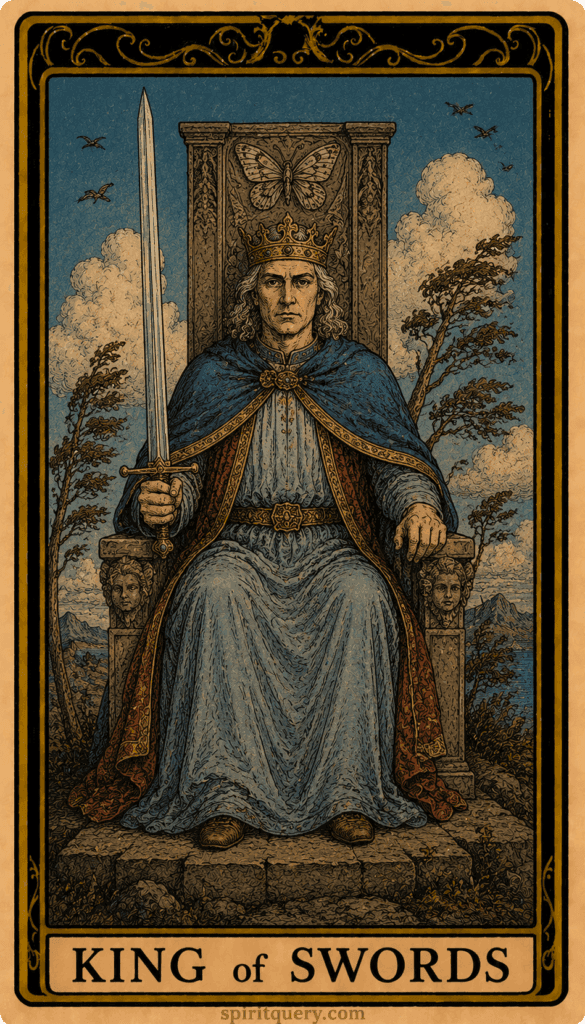
King of Swords
Keywords: Intellectual authority, fair judgment, strategic thinking, ethical leadership, rational decision-making, legal expertise
The King sits on a throne decorated with butterflies and crescent moons—symbols of transformation and intuition balanced with intellectual power. He holds his sword upright. His judgment is final.
What it actually means in readings:
This is mastery of the mind. The King of Swords is the judge, the lawyer, the strategist, the person who can analyze any situation objectively and make the fairest call.
He appears in legal matters, contract negotiations, situations requiring clear-headed leadership, and times when emotions need to be set aside to see what’s actually true and fair.
The King has authority not because he’s loud but because he’s right. He’s thought it through from every angle.
Watch out for: The King’s shadow is tyranny disguised as logic. “I’m just being rational” can become “I don’t care how this affects you.” Fairness without compassion is just cold judgment.
How to Read Multiple Swords in a Spread
One Sword: A specific mental challenge, decision, or truth you need to face
Two-Three Swords: Mental conflict, difficult communication, or a decision point requiring clarity
Four or more Swords: You’re living in your head right now. Overthinking, anxiety, or mental crisis dominates your life. Time to get grounded.
Watch the story they tell together:
If you pull Ace of Swords, Six of Swords, and King of Swords, that’s clarity → transition → mastery. You’re moving through mental chaos toward wisdom.
But Two of Swords, Nine of Swords, Ten of Swords? That’s avoidance → anxiety → inevitable crash. The thing you’re not looking at is going to hit you.
Swords Reversed: What Actually Changes
Reversed Swords generally show:
- Mental blockage: Can’t think clearly, brain fog, confusion
- Internal conflict: The battle is with yourself, not others
- Releasing the blade: Letting go of the harsh truth, the grudge, the need to be right
- Healing after the cut: Recovery from mental anguish or painful clarity
Context matters. Three of Swords reversed often means beginning to heal from heartbreak. Ten of Swords reversed can mean refusing to let it end—holding onto pain past its expiration date.
Frequently Asked Questions
Why are Swords so negative?
They’re not negative—they’re honest. Swords show you the thoughts, conflicts, and truths you’d rather avoid. That honesty can feel harsh, but it’s not cruel. The blade that cuts through illusion is the same blade that sets you free.
What if I keep pulling Swords cards?
You’re stuck in your head. Your mental state—anxiety, overthinking, conflict, or confusion—is dominating your life right now. The cards are asking you to address what you’re thinking and why you’re thinking it.
Are Swords always about conflict?
No. They’re about thought, communication, truth, and mental clarity. Conflict is one expression, but so is breakthrough insight, clear communication, fair judgment, and the courage to face hard truths.
What’s the difference between Queen of Swords and King of Swords?
The Queen’s strength is discernment and clear boundaries forged through personal experience. The King’s strength is objective analysis and ethical judgment. Both are intellectually powerful; the Queen knows through lived truth, the King knows through principled reasoning.
Can Swords predict actual physical danger?
Rarely. The Nine of Swords shows imagined danger, not actual threats. The Ten of Swords shows endings, not ongoing violence. Swords live in the mental realm. If you’re sensing actual danger, trust your gut—but verify whether it’s intuition or anxiety.
Continue Your Tarot Study
Explore the Other Suits:
- Complete Cups Guide – Emotions, relationships, and intuitive wisdom
- Complete Wands Guide – Action, passion, and creative fire
- Complete Pentacles Guide – Material security, health, practical matters
- Complete Major Arcana Guide – Life’s major spiritual lessons
Browse All Cards:
- View All 78 Tarot Cards – Complete card library
Final Thoughts on the Suit of Swords
The Suit of Swords meanings teach what most of us resist: your thoughts create your reality. Not your circumstances—your thoughts about your circumstances.
The person in the Eight of Swords isn’t actually trapped. The worrier in the Nine of Swords isn’t in actual danger. The figure in the Two of Swords already knows which path to take.
Learning the Swords suit means learning to watch your mind without being controlled by it. To recognize when your thoughts serve you and when they sabotage you. To speak truth without cruelty, to think clearly without coldness, to end what needs ending without drowning in regret.
The air element doesn’t ask you to stop thinking. It asks you to think clearly—to know the difference between intuition and anxiety, between necessary honesty and needless harshness, between wisdom and overthinking.
Your mind is a tool, not your identity. The Swords insist on this truth, card after card, reading after reading.
Learn their language. It’s the language of clear thought, hard truths, and the freedom that comes from finally seeing what’s real.
Trapped in your head or facing a difficult decision?
The Suit of Swords shows us our mental blocks, but you don’t have to navigate the confusion alone. Gain the clarity and honest insight you need to cut through the noise and find peace of mind.
Find Your Tarot Advisor Now 🔮Compare trusted platforms like Keen, Mystic Sense, and Psychicoz.