How to Read Tarot Cards for Beginners: A Step-by-Step Guide

Disclaimer: This post contains affiliate links. If you make a purchase through them, we may earn a small commission at no extra cost to you.
Most people who want to learn tarot get stuck in the same place: they buy a deck, flip through the cards, feel immediately overwhelmed by 78 symbols they don’t understand, and put it back in the box. If you are wondering how to read tarot cards for beginners, this guide skips the overwhelm.
This guide skips the overwhelm. You don’t need to memorize everything before you start. You need to understand how tarot actually works — and then use it.
What Tarot Actually Is
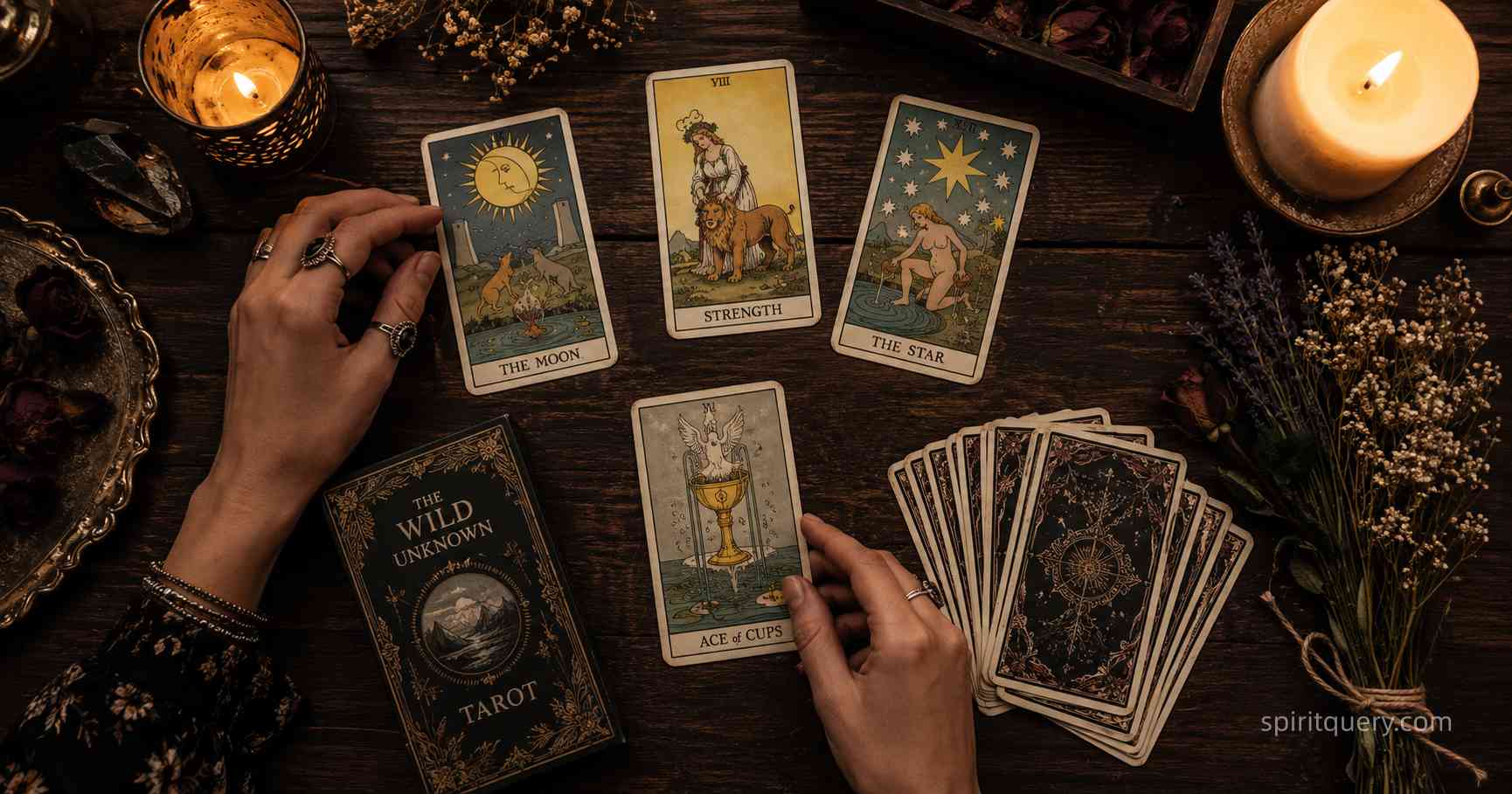
Tarot is a deck of 78 cards, each carrying a distinct image and meaning. It’s used as a tool for reflection — a way of surfacing things you already know but haven’t articulated, or seeing a situation from an angle you hadn’t considered.
It is not a prediction machine. The cards don’t tell you what will happen. They show you what’s present — the energies, patterns, and dynamics at play — and let you draw your own conclusions.
That distinction matters, especially when you’re starting out. The goal isn’t to receive answers from the cards. The goal is to use the cards to ask better questions.
The Structure of a Tarot Deck
Before you start reading, it helps to understand what you’re working with.
The Major Arcana — 22 cards
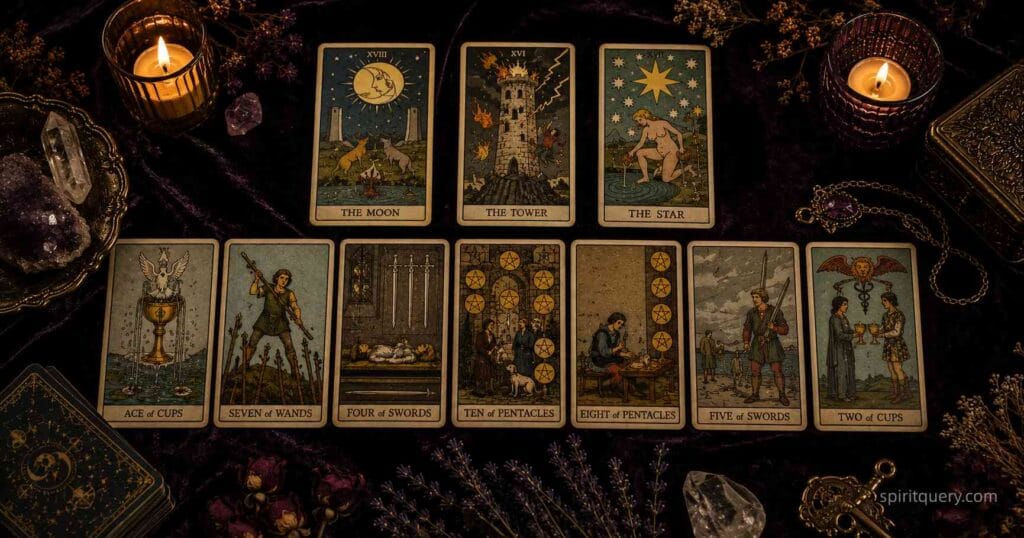
These are the big picture cards. They represent major life themes, turning points, and archetypal forces: The Tower, The Moon, The Lovers, Death, The World. When Major Arcana cards show up in a reading, they tend to signal something significant — a situation with real weight, not just everyday noise.
The Minor Arcana — 56 cards
These deal with the day-to-day. They’re divided into four suits:
- Cups — emotions, relationships, intuition, the heart
- Wands — ambition, creativity, energy, passion
- Swords — thought, conflict, clarity, communication
- Pentacles — money, work, the physical world, practicality
Each suit runs from Ace (new beginnings) through 10, plus four court cards: Page, Knight, Queen, King.
You don’t need to memorize all of this upfront. Just knowing the suits and their general themes gives you a working framework from day one.
Choosing Your First Deck
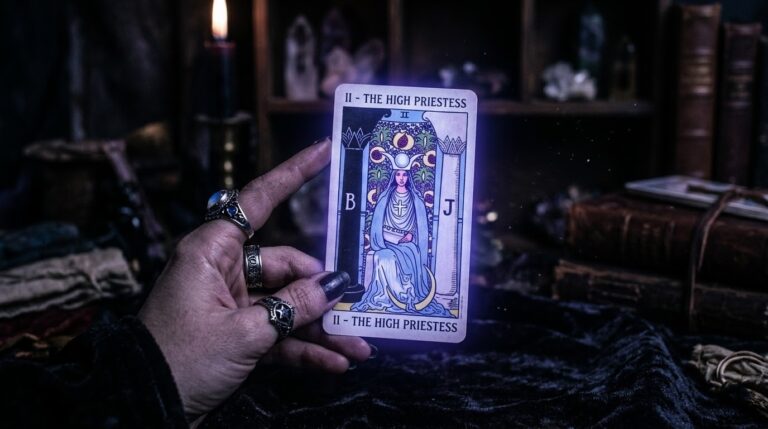
The Rider-Waite-Smith deck is the standard recommendation for beginners — and for good reason. Almost every tarot resource, book, and guide uses it as the reference point, and its imagery is detailed enough that you can often intuit meaning from the picture alone, even before you know the “official” meaning.
Other popular beginner decks: the Modern Witch Tarot (a Rider-Waite update with more diverse imagery), the Everyday Tarot (smaller, more portable), and the Light Seers Tarot (warmer, more contemporary feel).
The deck that feels right to you matters more than any specific recommendation. If you’re drawn to a particular deck’s artwork, that pull is information.
How to Read Tarot Cards for Beginners: The Practical Steps
Step 1: Get Familiar With Your Deck
Before doing any spreads, spend a few days just handling the cards. Look at each one. Notice what images catch your attention. Notice what feelings come up. You’re building an intuitive relationship with the deck before you layer in book meanings.
Step 2: Start With One Card a Day
Pull a single card each morning with a simple question: “What do I need to know today?” or “What energy is present for me right now?”
Look at the card. What’s the first thing you notice? What does the image make you feel? Write it down. At the end of the day, look at what you wrote and see how it connected to what actually happened.
This is how you build a real relationship with the cards — not by memorizing meanings, but by logging your own experience of them over time.
Step 3: Learn the Suits, Not the Cards
Before you try to memorize individual card meanings, internalize what each suit represents. Cups are emotional. Swords are mental. Wands are energetic. Pentacles are material. With that framework alone, you can make sense of most cards before you look anything up.
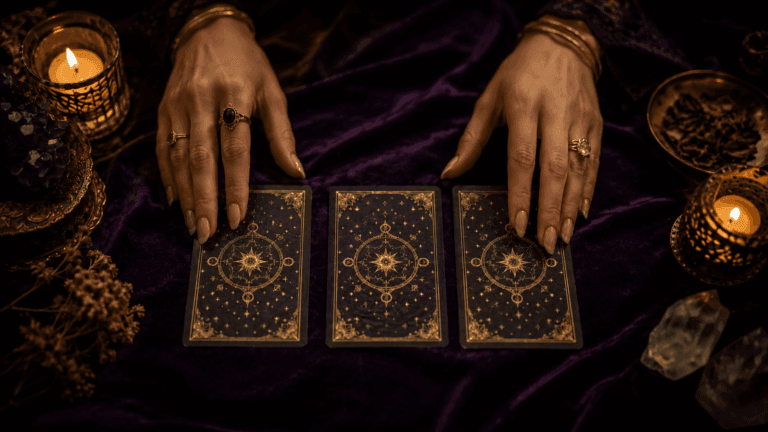
Step 4: Use a Simple Three-Card Spread
Once you’re comfortable with single-card pulls, move to a three-card spread. The most useful one for beginners:
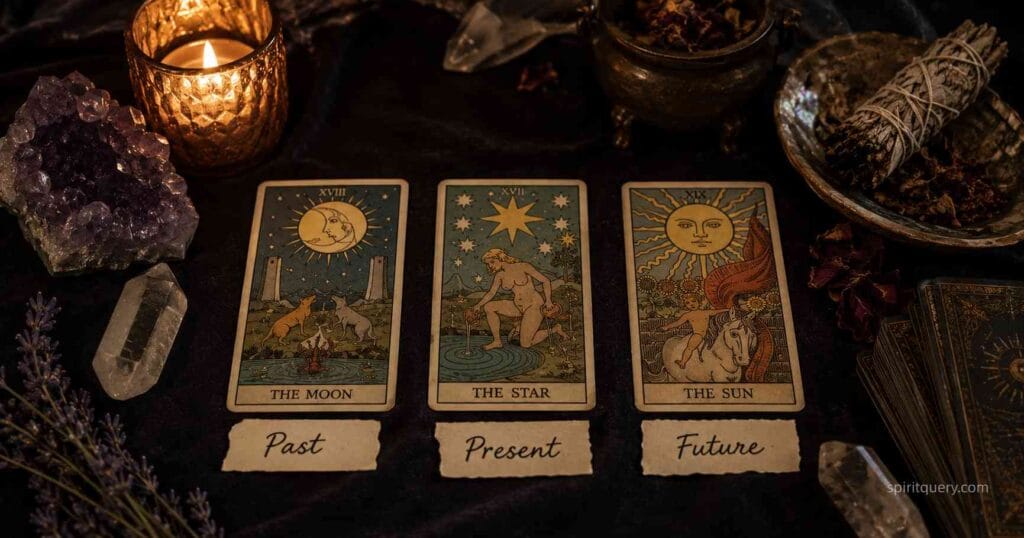
Past — Present — Future
Card 1: What led to this situation
Card 2: What’s happening now
Card 3: Where things are heading if the current energy continues
Or use: Situation — Action — Outcome
Three cards tell a story. Learning to read them as a narrative rather than three separate meanings is the real skill in tarot.
Reading With Intuition, Not Just Memorization
Here’s what most beginner guides won’t tell you: the book meanings are a starting point, not the final word.
Every card has a traditional meaning, and learning those meanings is useful. But tarot reading is also contextual — the same card means something different in a love spread than it does in a career spread, and something different again depending on what cards surround it.
The readers who get the most out of tarot — and who develop the most accurate intuition over time — are the ones who let themselves respond to the image first, then check the book, then synthesize both. Your gut reaction to a card is data. Don’t skip it.
Common Beginner Mistakes
Asking the same question multiple times.
If you pull cards on the same question three times in a row because you didn’t like the first answer, you’re not reading — you’re fishing. Pull once, sit with it.
Reading every card as a literal prediction.
The Three of Swords doesn’t mean heartbreak is coming. It means heartbreak-energy is present. The difference matters. Tarot describes the landscape, not the destination.
Expecting to be good at it immediately.
Tarot is a practice. The people who read with real depth have been doing it for years. Give yourself the learning curve without judgment.
Avoiding “negative” cards.
Death doesn’t mean someone dies. The Tower doesn’t mean disaster. The Devil doesn’t mean evil. Some of the most powerful growth in a reading comes from the cards people instinctively want to avoid.
When to Seek a Professional Reading
Learning to read for yourself is valuable. It builds self-awareness and gives you a tool for reflection that you can use anytime.
But reading for yourself also has a real limitation: objectivity. When you’re emotionally invested in the question, it’s hard to read the cards without projecting what you want to see. That’s not a failure of skill — it’s just how human psychology works.
A professional reader brings outside perspective, experience with complex spreads, and the ability to see what you can’t see when you’re in the middle of it. If you’re working through something significant — a relationship question, a major life decision, a situation you’ve been circling for months — a skilled reader at spiritquery.com can offer what self-reading can’t.
Frequently Asked Questions
How do I read tarot cards for beginners?
Start with one card a day, using a simple question like “What do I need to know today?” Get familiar with the four suits and their themes before trying to memorize individual cards. Move to three-card spreads once single cards feel comfortable. The skill builds through practice, not through memorization.
Do I need to memorize all 78 card meanings?
Not before you start. Learn the suit themes first — Cups for emotions, Swords for thoughts, Wands for energy, Pentacles for the material world. Individual meanings come naturally with time and regular use.
What is the best tarot deck for beginners?
The Rider-Waite-Smith deck is the standard recommendation because its imagery is detailed enough to guide intuition, and most learning resources reference it. The Modern Witch Tarot and Light Seers Tarot are good alternatives with more contemporary imagery.
Can anyone learn to read tarot?
Yes. Tarot doesn’t require a special gift — it requires practice, attention, and a willingness to sit with ambiguity. Most people who stick with a daily one-card practice for 30 days develop a workable intuition with the deck.
How long does it take to learn tarot?
You can do useful single-card readings within a week. Three-card spreads take a few weeks to feel natural. Complex spreads and nuanced readings take months to years of regular practice. There’s no endpoint — experienced readers still learn from the cards.
What does it mean when you pull the same card repeatedly?
It means the energy or theme represented by that card is persistent in your life right now. The deck is flagging something that hasn’t resolved yet. Rather than trying to avoid the card, lean into what it’s pointing at.
Ready to go deeper than self-reading allows? Explore trusted tarot readers at spiritquery.com — vetted advisors who can offer the outside perspective that changes things.